
Why Is My RV Water Heater Not Working?
Often, an RV water heater stops working for a simple reason. The usual suspects are a switch, a breaker, an empty propane tank or a bypass valve still set for winter. When those check out, the fault is often one part on one heat source.
So start with one question: does it fail on propane, on electric or on both? If the checks below do not bring the hot water back, it is time for RV water heater repair.
Does it fail on propane, on electric or on both?
Many RV water heaters heat one tank with a propane burner and a 120-volt element. Each side has its own parts, but some heaters share 12-volt controls, so one bad part can stop both. This guide draws on two heater makers’ manuals, one for steel tanks and one for aluminum tanks.
| What you notice | Likely causes | Check first |
|---|---|---|
| Propane fails, electric works | The propane supply, a blocked burner tube, the igniter or the gas valve | The propane supply |
| Electric fails, propane works | No 120-volt power, the element, the thermostat or the high-limit switch | The breaker and switches |
| Both fail | A bypass valve, a tank not full, low 12-volt power or a shared control | The bypass valves and battery |
| Lukewarm water | A bypass valve partly open, a weak thermostat, sediment, slower electric-only heating | The bypass valves |
| Soot or a yellow, lazy flame | Poor burning, often from a blocked burner tube | Shut it down; call a technician |
What can an owner check safely?
Most of these checks need only a flashlight. Keep the heater off unless a step says otherwise.
- Water in the tank. Open a hot faucet until water runs steady with no spitting air. Both makers warn against running the heater with an empty tank.
- The bypass valves. After winterizing, the valves at the back of the heater may still send water around it.
- Switches and power. Check the inside switch panel and any electric switch behind the outside door. Electric needs shore power or the generator. Spark models also need at least 10.5 volts from the 12-volt system.
- Propane. Make sure the tank valve is open and the tank has propane. If the lockout light is on, switch off, wait 30 seconds and switch back on.
- The outside door. With the heater off and cool, look at the vent screen for webs or nests. Spiders and mud wasps nest in burner tubes.
If it locks out again after a reset or two, stop there. If you smell propane, get everyone out of the RV, then shut off the tank valve. Do not touch electrical switches or start the engine or generator, the steel-tank maker says. Call the gas supplier or a technician from outside.
Why does it work on electric but not on propane?
Spark models try to light three times, then lock out and turn on a reset lamp. Listen at the outside door.
- Clicking but no flame. Gas is not getting through. Look for low gas pressure, low voltage, a blocked burner or a failed gas valve.
- No clicking at all. Suspect the igniter, its wiring, a blown fuse, a melted thermal cutoff or the control board.
- It lights, then goes out. Low gas pressure, low voltage, a dirty igniter or a weak ground can do that.
A melted thermal cutoff can follow a drive or a blocked flue. The aluminum-tank maker says to turn the propane off while the RV moves, since wind can push the flame back. A technician then clears the cause and replaces the cutoff. Gas pressure tests and leak checks belong to RV propane system service.
Why does it work on propane but not on electric?
If the breaker and switches are on, suspect the element, the thermostat, the high-limit switch or a 12-volt relay. The high-limit switch, often called the ECO, cuts the heat if the thermostat fails and the water overheats.
On some aluminum-tank models it trips above 170 degrees and resets with a button under a cover. That cover hides 120-volt wiring, so turn the power off before anyone opens it. An ECO that keeps tripping usually means the thermostat failed or lost contact with the tank.
Electric heats more slowly than propane, so a slow heat-up can be normal. If no 120 volts reach the heater, the fault sits upstream in the wiring or shore power. Tracing it is a job for RV electrical repair.
What do the anode rod and sediment have to do with it?
Steel tanks carry a magnesium or aluminum anode rod that corrodes in place of the tank. The steel-tank maker recommends a new one every year, or when more than 75 percent is gone. Aluminum tanks use a plain drain plug, and their maker warns that an anode there damages the fitting.
Sediment on the tank bottom insulates the water from the burner and overheats the bottom, the steel-tank maker says. That shortens the tank’s life.
Hard water adds to it. San Marcos city water averaged 269 parts per million of hardness in the city’s 2024 water quality report. The USGS calls anything over 180 very hard, and heated hard water leaves calcium carbonate deposits.
Draining and flushing clear sediment, and draining guards against freeze cracks. NOAA climate normals for San Marcos count about 20 days a year at 32 degrees or colder. Before you drain, turn off the power and the propane and let the tank cool. Shut off the water pump, then open a faucet.
If you winterize with antifreeze, bypass and drain the heater first, since the steel-tank maker says antifreeze eats the anode. A flush and an anode check fit well into yearly RV maintenance.
When does replacing the water heater make sense?
Most failures come down to one part, which costs less than a new heater. Replacement makes sense when:
- Water leaks from the tank itself. Pinhole leaks from corrosion can make a tank fail, the aluminum-tank maker’s service guide says.
- The tank cracked in a freeze.
- Several major parts need replacing at once, and the total nears the price of a new heater.
- You want more hot water than your tank holds. A technician can check whether a larger or tankless unit fits.
What does RV water heater repair cost?
The part and the heater set most of the price. One national RV repair cost guide, built from 2026 invoices and estimates, lists these totals for parts and labor.
| Repair | Published market range |
|---|---|
| Heating element replacement | $180 to $400 |
| Thermostat replacement | $150 to $350 |
| Gas valve replacement | $250 to $550 |
| Anode rod replacement (steel tanks) | $80 to $200 |
| New 6-gallon tank heater | $600 to $1,400 |
| New 10-gallon tank heater | $750 to $1,600 |
| Tankless water heater upgrade | $1,400 to $2,800 |
The same guide puts mobile technicians at $125 to $200 an hour, plus $95 to $250 for the service call. These are market numbers, not our price list.
Who fixes RV water heaters around San Marcos?
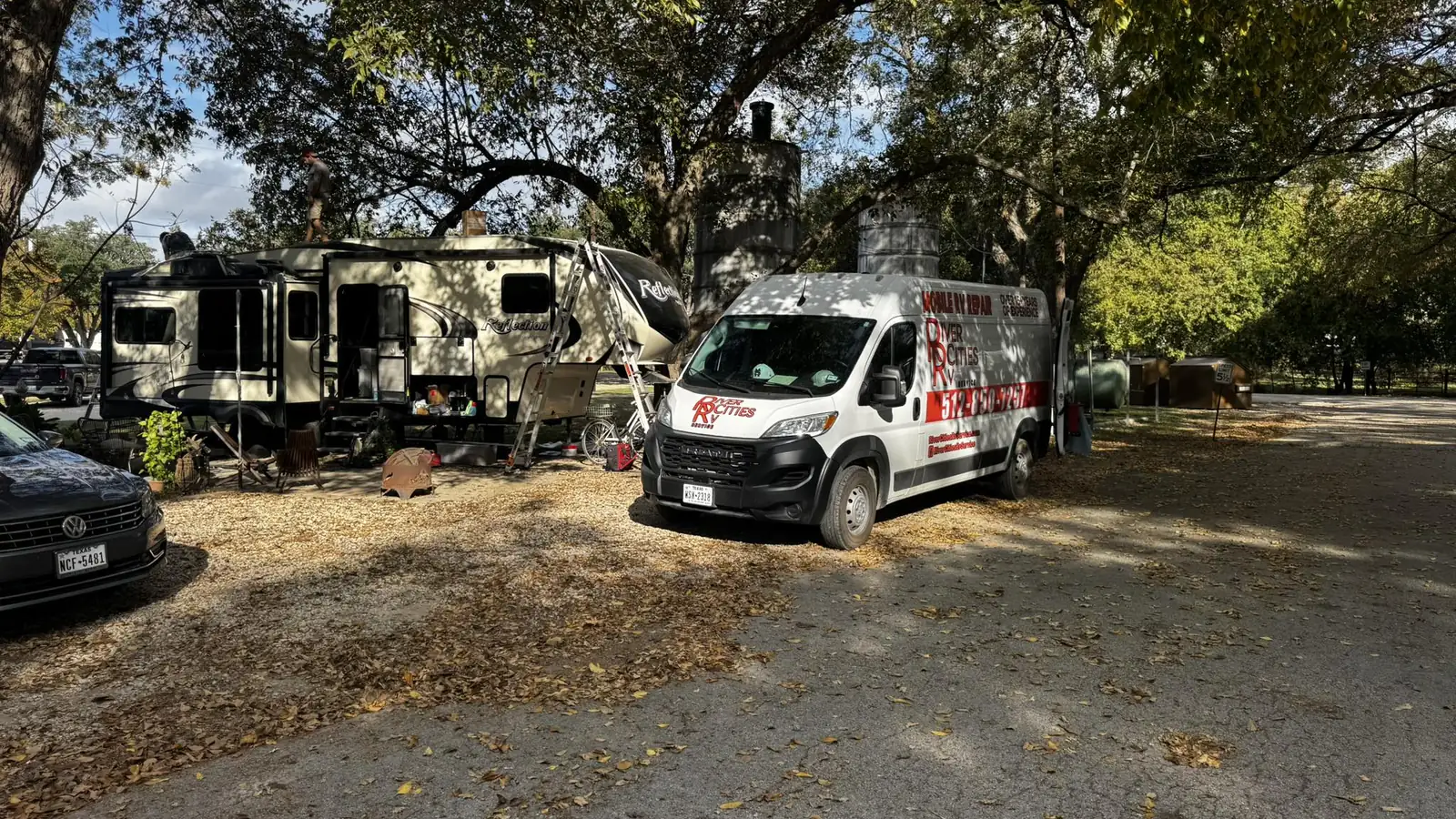
River Cities RV Service repairs RV water heaters where the RV sits, within about 50 miles of San Marcos. That covers travel trailers, fifth wheels, motorhomes and campers at RV parks, campgrounds, storage lots and driveways. You can also bring the RV to our San Marcos shop.
The service call covers the diagnosis and the trip, and the quote for the repair goes in writing. See what RV plumbing and water heater repair covers, or call or text (512) 850-7257.